RoRvsWild
Ruby APM and error tracking for Rails
How it started
Back in another life, we worked at a VC-funded music startup. Performance and reliability mattered when traffic spiked around new releases. We used New Relic. It worked but was expensive, complicated, and mostly overkill. We didn’t mind; we were playing with the rich kids’ toys, and there wasn’t much else.
The startup eventually burned through its funding. We returned to reality and started Base Secrète, building Rails apps for clients and ourselves. One side project, disco.io, grew complex fast: millions of background jobs, real performance problems, and no realistic path to revenue. New Relic wasn’t an option.
We tried other tools. Nothing fit. We needed one place for requests, jobs, and errors, cheap enough for a side project with no revenue.
So we designed and built our own tool and started using it on every project.
In a nutshell
RoRvsWild monitors Ruby on Rails applications end-to-end:
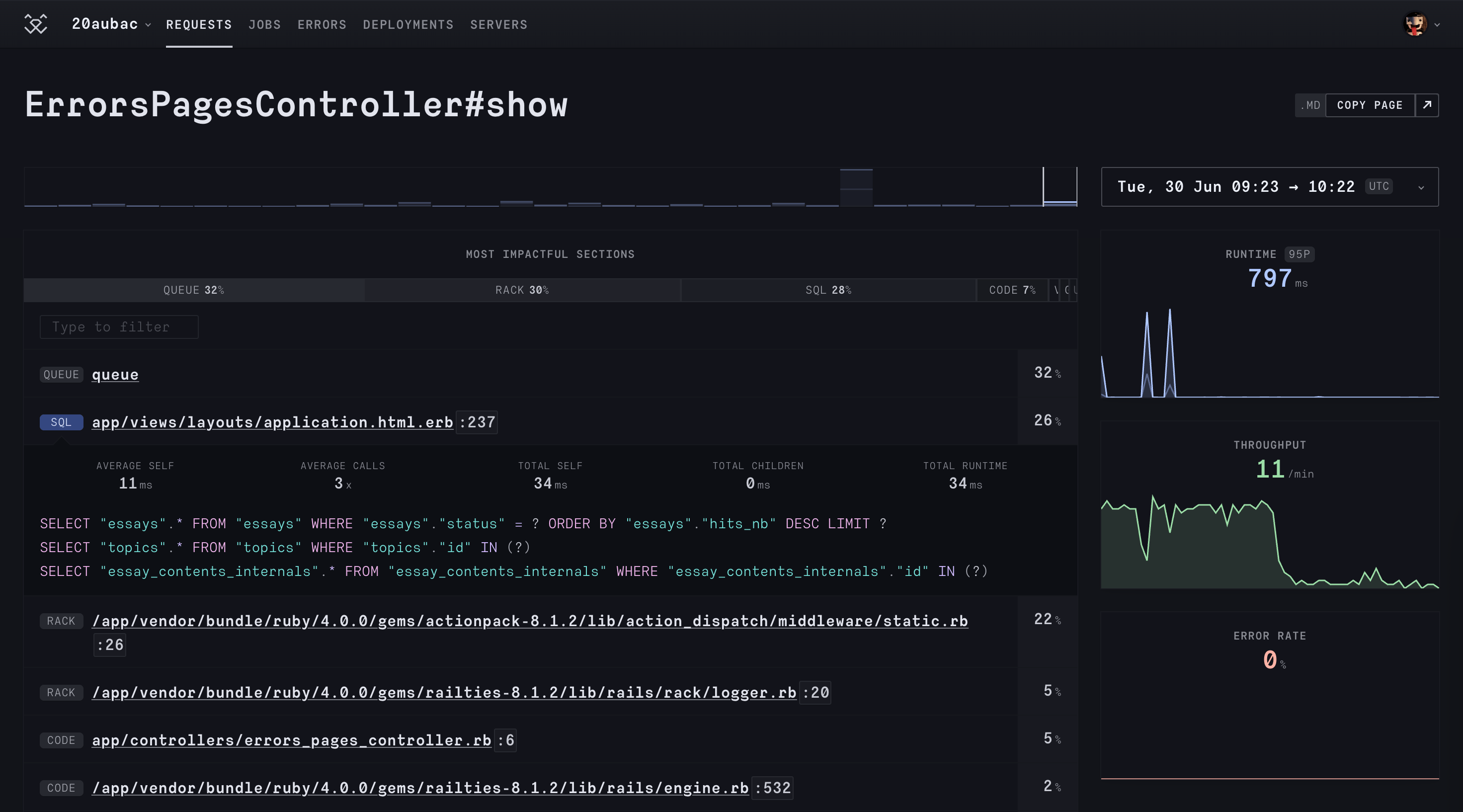
- Requests: response times, throughput, and bottlenecks in your code.
- Background jobs: ActiveJob, Sidekiq, GoodJob, Solid Queue, Resque, and DelayedJob.
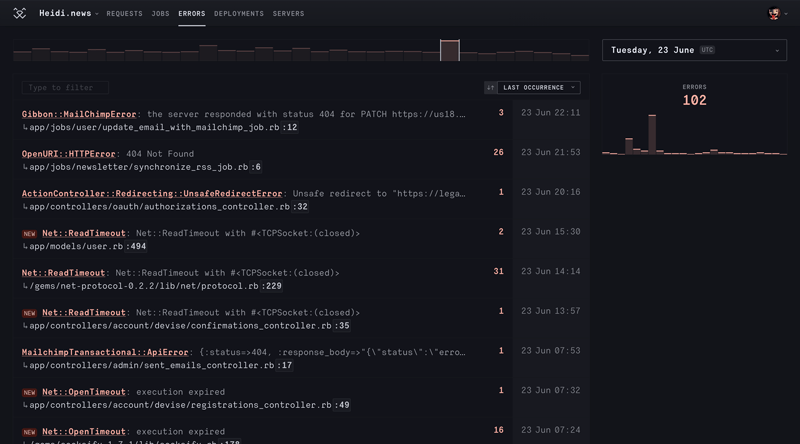
- Errors: notifications by email, Slack, Discord, or Teams, with the context you need to fix them.
- Deployments: automatic tracking of code revisions and their impact on performance.
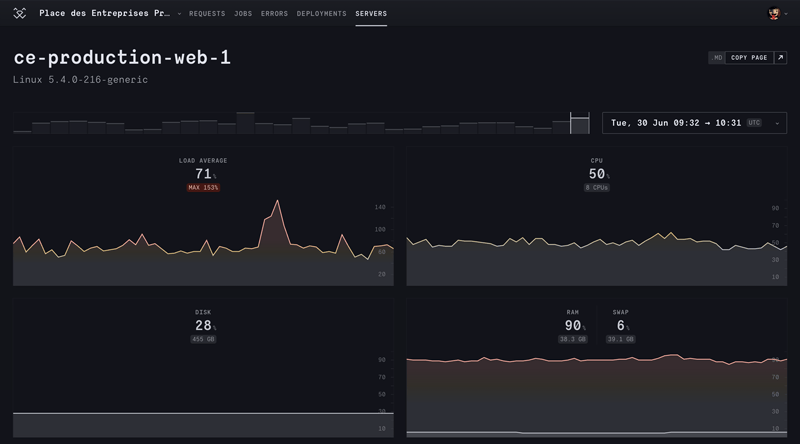
- Servers: load, RAM, swap, CPU, and disk space, with alerts when things get tight.
The open source Ruby gem can also profile requests locally in development, without sending data to our servers.
RoRvsWild is available on the web, with iOS and Android companion apps for on-the-go monitoring.
Design
RoRvsWild is Ruby on Rails only. That is a deliberate choice: one stack, one gem, no polyglot agent to maintain.
Most Rails teams, like ours, are small. They don’t have a dedicated DevOps or SRE team. Developers handle performance and errors themselves, and they need to do it fast so they can get back to shipping.
The UI is dark first, with a monospace font, so developers feel at home. The slowest endpoints sit at the top so you know where to focus. Charts highlight the general trends and spikes, but are secondary. Requests, jobs, and errors share the same navigation, so you don’t relearn the tool as you move between screens. AI agents get token-efficient markdown versions of every page.
Everyone on the team should understand in record time what’s worth fixing, and in what order.
We store the collected data for only 30 days, so we can keep the pricing low. What matters is what’s happening now and recently.
So I found RoRvsWild. Simple, slick, well done.
Stefan Botzenhart
Under the hood
RoRvsWild is a Rails application on PostgreSQL and Redis. The agent measures request times, job durations, SQL queries, and exceptions, then sends that data asynchronously so monitoring doesn’t slow down the apps it watches. It runs on any Rails hosting (Heroku, Scalingo, a VPS) and instruments Redis, MongoDB, Elasticsearch, and supports every SQL database.
The iOS and Android apps run on the same Rails application through Hotwire Native, so they have thin native codebases and don’t require App Store reviews for small updates.
How it’s going
RoRvsWild is the tool we open every morning on our own apps, including the ones we run for clients like Switzerland’s largest newspaper, Le Temps. Like-minded developers worldwide also use and praise it for its efficiency.
Build more, monitor less.
I see RoRvsWild as a Datadog alternative that doesn’t require a PhD. Just install the gem, push to prod, and see what can be optimized.
Yaroslav Shmarov
We also wrote about RoRvsWild vs. New Relic.